

Full disclosure, this concept began as a podcast idea. Essentially I was reading The Lord of the Rings for the first time, being a huge fan of the movies, and kept thinking, wouldn’t it be fun to talk through all of the changes chapter by chapter? Well, podcasts take a lot of work, but a blog I can write in a few hours! I may still make the podcast someday, I have talked with several people about co-hosting, but for now, I thought, why not start a new blog series and talk about the biggest highlights of some of my favorite book to film adaptations? Of course, the Lord of the Rings would be a huge undertaking, but I recently re-read Carrie by the legend himself, Stephen King, and found a lot to talk about. Here are 5 notable differences between Carrie the novel and Carrie the film, directed by Brian De Palma!
WARNING! Major Spoilers Ahead!
Carrie is overweight in the novel
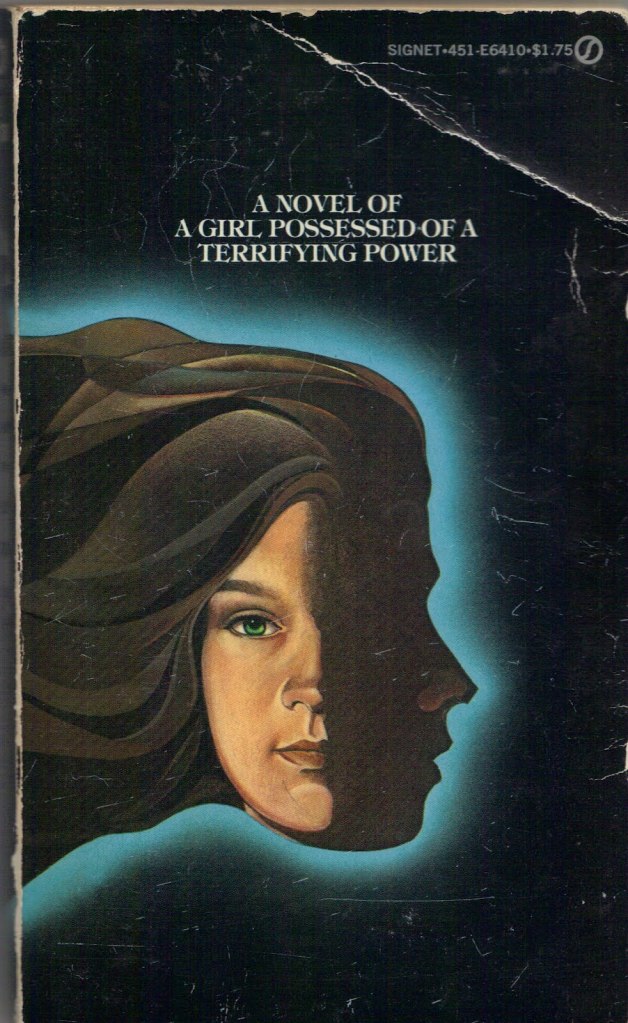
Sissy Spacek’s performance as the title character is nothing short of phenomenal. Her transition throughout the film from meek and timid, to gradually discovering confidence as she embraces her powers, to downright menacing in the final act, is a master class of acting. But there’s one notable way in which Spacek does not embody Carrie White: Spacek is stereotypically attractive. Meaning she is thin, and her skin is smooth. Carrie, as described in the novel, is overweight and has acne, however King still makes it a point to state that she is beautiful.
King has a bit of a rocky history with weight-shaming, namely that he often associates obesity with his antagonists. Momma, also known as Margaret White, is one such antagonist. He describes her as “very big woman” and notes how her feet nearly overflow her shoes. He even goes so far as to imply that she is keeping Carrie overweight on purpose by frequently feeding her desserts, as a means of oppressing her. This suggests that he sees Carrie’s weight not as a perfectly natural state of being, but as one of many abuses her mother has inflicted upon her.
That being said, King goes out of his way to abolish the notion that her weight makes her unattractive, and there’s something to be said about that. Though she suffers from body dysmorphia and regards her own face as “bovine,” she finds herself admiring some of her own body parts in the mirror early in the novel. Later, her prom date Tommy, who is genuinely falling for her, tells her very sincerely that she is beautiful. King follows this up in the narration with “she was.” As an overweight, bad-skinned teenager myself at the time I first read this, that struck something deep in me. If Carrie could be overweight and beautiful, maybe that meant that I was beautiful too. I’ll always be grateful to Sai King for that one.
The novel intersperses the main plot with future news articles and essays describing the incident, which include commentary on patriarchy.
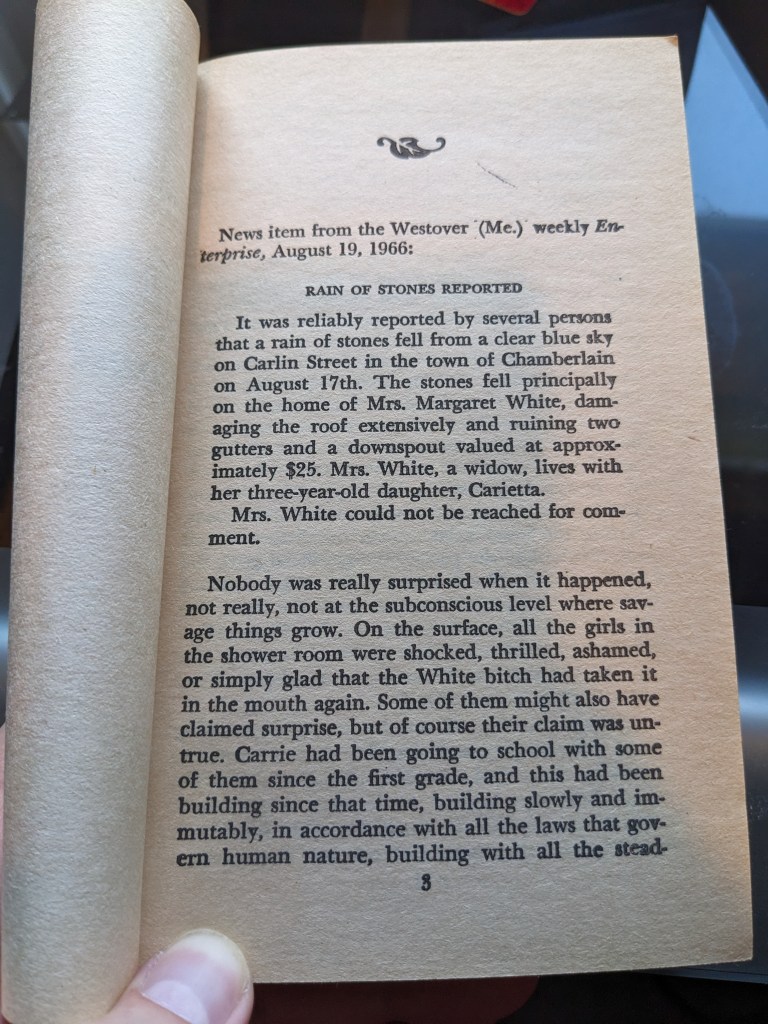
Nearly every time the action changes perspective in the novel, King inserts asynchronous “real world publication” segments such as fictional news articles, interviews, and essays about the event. This was done primarily to increase the word count, so it could be sold as a novel instead of a novella or short story, as it was originally conceived. Despite the utilitarian nature of that decision, it adds a ton of meat to the book, filling in backstory, foreshadowing the events to come and adding a palpable sense of dread, and also injecting commentary on patriarchy into the text.
Most notably, it is determined by scientists that the telekinesis (often referred to simply as “TK”) gene is dominant in women and recessive in men. Therefore they conclude that “isolating and eradicating this gene should be one of medicine’s top priorities.” Says a lot about our culture’s attitude toward women with power, doesn’t it?
The scope of Carrie’s rampage is much larger in the book
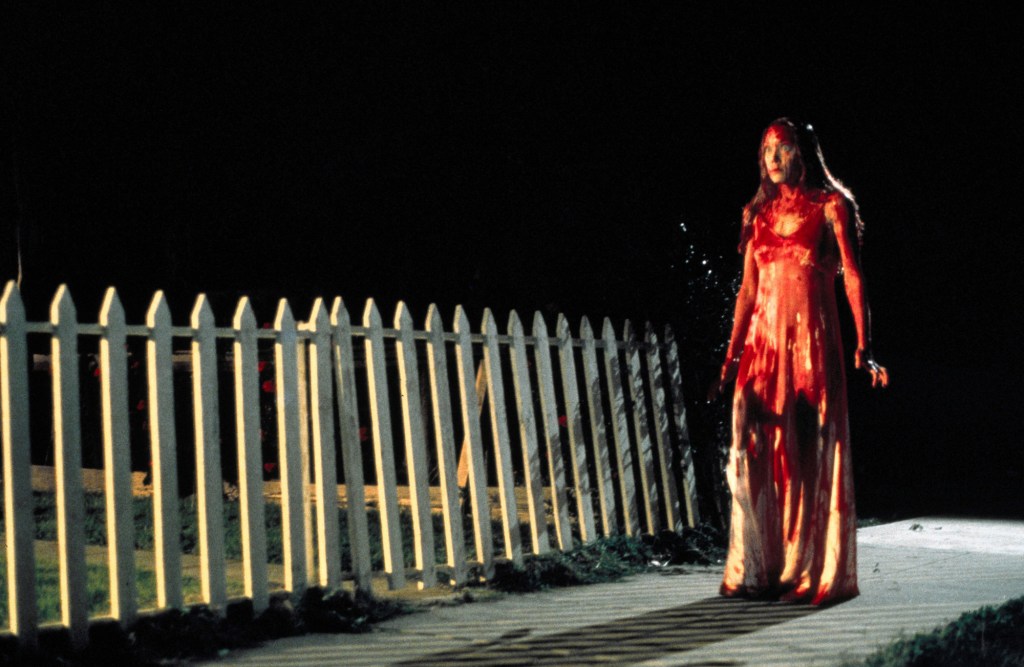
In the film, Carrie’s killing spree is contained to the prom, Chris and Billy, and Momma. In the novel, the hell rained down on Chamberlaine, ME by that bucket of pig’s blood is substantially worse.
A film is essentially a zero-sum game, which means that every minute spent on one bit of plot means less time spent on another, or runs the risk of lessening the overall impact by losing the audience’s interest. In that regard, I think paring it down to the most important bits and keeping the focus on the main characters was a wise choice and a credit to the film. A book, on the other hand, can be crammed full of as many details as the author likes, and if they’re all good, the reader is usually happy to spend some extra time in that universe and soak it all up.
Here is a brief synopsis of what happens on “Prom Night” after Carrie gets doused with pig’s blood in the novel: She runs from the gym crying, then goes back. She locks the gym doors and turns on the sprinklers. A band leader gets elecrocuted, someone gets their fingers severed in the doors, and a fire is started from the water hitting the stage equipment. She holds the doors close with her mind as she walks away. And oil tanker near the school explodes. As she makes her way through the town, she blows up multiple gas stations, and fire hydrants as well, so the fires can’t be put out. She enters a church and prays, then comes out and kills bystanders by breaking power lines and electrifying the water flooding the street. The wreckage causes Chamberlain to be cut off from the outside world, and the final death toll is 409, with 49 missing.
So she more or less murders the whole town. Pretty brutal stuff.
Billy is much scarier in the novel

One of King’s biggest strengths is creating bully characters with just an extra edge of menace to them, the type you went to school with who you wouldn’t be at all surprised to find out later in life that they snapped and killed someone. The blind aggression that young people wrestle with when they lack the sense and wisdom of later adulthood can be uniquely terrifying. King’s most famous example of that is probably Henry Bowers from “It,” but Billy Nolan might be his most frightening.
John Travolta’s depiction is a fine piece of acting, but it’s a watered down version of the character. Right off the bat you get the sense of a very different personality. He is described in the book as a brooding greaser type in a leather jacket who almost never smiles, while the film version is more of a joy-riding frat boy in a hunting vest looking for a good party. Both depictions are abusive, but Billy’s abuses go far deeper in the book than in the film version.
King puts the reader in his perspective, and we learn that he intends to go through with the prank regardless of Chris’s involvement. Not because he has anything personal against Carrie White, or even knows much about her, but because he just wants to soak a woman in blood. While setting up the prank he thinks “any of the others would be alright too.” When they butcher the pig to gather the blood, he kills a second one for no reason. He cracks a rare smile when he says the farmer whose pig they killed was at his mother’s funeral. He knows his friends’ fingerprints are on the bucket, and gets satisfaction over knowing they will likely be caught. And not only does he abuse Chris, he rapes her, and threatens to kill her if she rats him out. Nearly all of this was cut from the story for the film, making Travolta’s rendition a one-dimensional bad guy.
In the novel, Billy and Chris die last. In the film, Momma dies last.

While Billy might be the novel’s most dangerous villain, the most memorable one is absolutely Margaret White, Carrie’s mother, referred to as “Momma” from Carrie’s perspective. Momma is the reason for Carrie’s isolation, having raised her with puritanical Christian values, shunning ideas of sex or even innocent affection from boys, forcing her to pray for forgiveness for natural human impulses, beating her for disobeying and frequently locking her inside a closet. It’s a kind of personal hell that I can’t even imagine living through. She is the most imposing, most impactful force in Carrie’s life, so imagine my surprise when I re-read the book recently and was reminded that her death is not the final moment of Carrie’s massacre.
In the film, after leaving the school Carrie encounters Billy and Chris on the street, and dispatches them very quickly by blowing up Billy’s car, before going home to confront Momma. In the novel, she stops at home to kill Momma first, and then tracks down Billy and Chris at a bar called The Cavalier. It’s a fascinating difference and one that I think drastically changes the impact of the ending.
In the book, King sets up Billy as both an embodiment of sexism and a parallel for Carrie’s father, who we learn impregnated Margaret against her will and then walked out. Carrie’s father is seen as the originating point of Carrie’s condition, having abused and traumatized her mother before her mother in turn abused and traumatized her. Because Carrie’s father is not in her life, Billy becomes the stand in, and the confrontation at the end can be seen as Carrie confronting all of the abuses that men inflict on women. Thematically, it works, but if you really think about it, Billy’s actual impact on Carrie’s life only comes down to a single moment: the Prom night prank. There’s obviously more history between her and Chris, but by then Chris is no longer driving the proverbial car. It’s a great sequence, but when you take a step back and look at the whole story, the notion that this is the most important encounter feels a little flimsy from a character-focused perspective.
Even had Billy’s part not been cut down drastically for the film, I would still argue that ending with Momma’s death was the correct choice, and a truly inspired decision by the screenwriters. Margaret may be a victim of trauma herself, but from Carrie’s perspective, Momma is the source of it all. The one who hurts her, the one who taught her to be ashamed of herself, and yet the one on whom she must still depend for her needs. All of the carnage that ensues on prom night can be viewed as a direct result of Carrie’s act of defiance against Momma. It’s by far the emotionally powerful conflict in the story, and let’s not forget to mention that Piper Laurie’s performance is pristine. I can’t imagine the film ending any other way.
So what do y’all think? Do you have a preference for one of the other? Did I miss any other interesting differences? Let me know in the comments!
 Ryan Charles Lieb